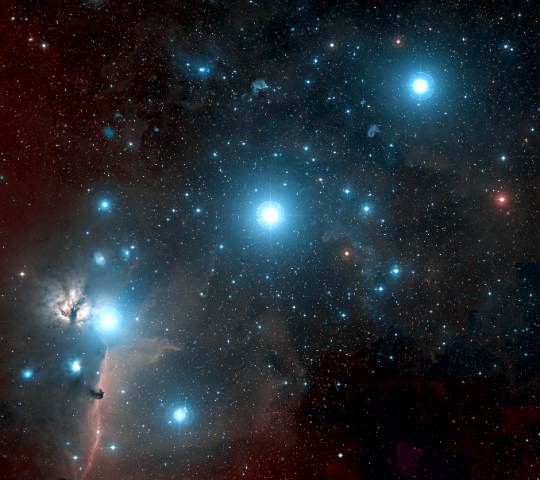
Last week I watched a fascinating documentary on Stanley Kubrick. Arthur C. Clarke was talking about Kubrick's 2001:A Space Odyssey. Something he said was thought-provoking that has really stuck with me, especially because I walk under the stars every night when I walk my dogs. Clarke said that behind every person was 30 ghosts. For every one human living there were 30 dead; this adds up to about 100-150 billion people who have ever walked the earth. That's about the same number as the stars in the sky. Clarke said, isn't it amazing that the Universe is so big that each person that has ever existed might have an entire world to themselves?
That's beyond my comprehension. If you really try and comprehend the sheer size of the Universe, you'll soon find it impossible. Our brains (as advanced as they are) do not have the ability to comprehend the vast size of our universe. To put it into context, the moon is about 500,000 miles away from earth. To travel around the Earth and end up at the same point, one must travel about 40,000 miles. The moon is more than ten times further than that distance, and that is the closest celestial body to our planet! The closest planet to Earth, Venus, is 25 million miles away. To travel 1 million miles on Earth, one would have to circle the planet nearly 30 times. To say we cannot comprehend the size of the universe is an understatement.
It is the most beautiful thing to look up in the sky at night and imagine where all those stars are. For all the shapes stars make in constellations, they are millions if not billions of miles away from each other. Such thoughts truly make me feel small, but it assures me that there is far more beyond this planet than most people bother to imagine. Next time you get the opportunity to look at the stars, see them and imagine the vastness of this universe. Even though we will never comprehend such size, it is an exercise enough to try.
Read more...
Saturday, December 6, 2008
Billions and Billions of Stars...


Wednesday, May 14, 2008
Red Queen
 Since I've been sick these last couple days, sitting still in my bed, my mind has been busy at work while my body refuses. Being sick reminded me of a book I read about a year ago, called Red Queen: Evolution in Human Nature. It's about this constant race that humans have with bacteria and viruses. Our immune systems and viruses are constant adapting to do battle. A virus will evolve constantly until it can find a host. That host must adapt and evolve as well if they hope to beat the virus and return to good health. The author uses Lewis Carroll's character, The Red Queen, as a metaphor for this constant struggle. No matter how fast or long the Red Queen runs, she is always in the same place. It's an effective metaphor because the balance between human and microbes is ever-fragile. Each holding the keys to each other's destruction, yet never quite able to finish the job. This stuff is normally fascinating to me, but being sick gives me a chance to witness the exchange first hand.
My immune system is now struggling to defeat whatever internal infection I have. It could be bacteria or a virus. Either way, something is multiplying exponentially inside me. While the microbe multiplies, my immune system is busy not only trying to defeat the invader but also make copies for later. That microbe will never be able to penetrate again, even though it doesn't do much good. At the rate of reproduction, a virus can easily multiply thousands if not millions in a few days. Each of those viruses are different genetically, each hoping to find a host in which to replicate some more. Inside me, a battle is raging. My immune system will probably win out, but whatever I have will live on many generations. In the end, the microbes will win. They lose so many battes, but in the end they will win the war.
Evolution is always fascinating. Knowing that everything is always changing around us is stunning. We are always changing, but never really going anywhere. Our balance is at best tenous, and anything can happen at any time. It adds value to a world than many take for granted. The more I learn about little things like this, the more insignificant I feel. But it's not a bad insignificance. Even the most famous people of our time will be gone in a few hundred years as generations slowly forget. Being insignificant reminds me that everything continues on, whether anyone's here or not.
Read more...
Tuesday, May 6, 2008
To Protect and Delay

I've been meaning to complain about something that I feel does little good: speedtraps. I don't drive very much, but I do take the bus home from work every day. Today traffic was especially horrendous, some may chalk it up to regular DC Metro area traffic, but I saw something else. Three or four police cruisers were pulling over vehicles for assorted offenses; they were writing the tickets as the bus slowly crept by. As I watched those patrol officers doing their job, I had to think: is this necessary? Is it possible that this speed trap, which has all the best intentions, actually making traffic worse? How does one weigh the supposed greater good versus efficiency of traffic? Anyone who knows me knows the answer to that question, especially when the greater good being served is not clear at all.
I believe that those police officers are actually making more traffic simply by being there. Everyone knows that driving behavior changes when the boys in blue are out. Suddenly everyone's hands are at ten and two, their seatbelts are quickly clasped and most importantly, they slow down to or below the speed limit. I'm all for safety, but sudden slowdowns caused by traffic police presence is not for the greater good. What happens is a giant accordion effect, like a catepillar contracting before expanding. Traffic all slows down, and the effect trickles further and further back. Before you know it, the police have caused far more traffic by simply being present than if they were not.
There are other ways to monitor driving behavior, like cameras and sensors. In Germany, the police would put a radar in the back of a beat up van, pulled over on the side of the road snapping pictures and speeds of passing drivers. These unintrusive devices can ensure a steady flow of traffic while satisfying the need to catch speeders. I simply argue that a police officer's presence during an already congested rush hour is more harmful than good. Traffic inevitably slows, making congestion that much worse. Are the few speeders caught worth the headache that the police cause simply by being present?
Read more...
